Moving Average Convergence/Divergence (MACD)
MACD Trading Strategy Guide
The MACD Commodities Technical Indicator was developed by Gerald Appel.
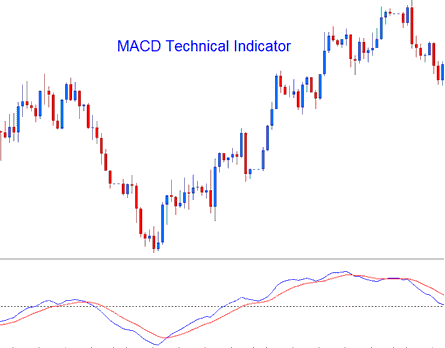
The MACD Commodities Technical Indicator is one of the simplest, most reliable, and most commonly used technical indicators available. The MACD is a momentum oscillator with some trend-following characteristics. MACD Technical Analysis in Commodities Trading - The most popular commodities trading technical analysis of the MACD indicator first calculates the difference between two moving averages and draws this as the MACD "Fast " line: and A second MACD "Signal " (trigger) line - the commodities trading signal line is calculated from the resulting MACD "Fast " line and drawn in the same frame as the "Fast " line. The "standard " MACD values for the MACD indicator "Fast " line are a 12-period exponential moving average and a 26-period exponential moving average and a 9-period exponential moving average for the MACD indicator "Commodities Trading Signal " line.
MACD Commodities Strategy Lesson - Understanding MACD Technical Indicator
The MACD indicator is widely used as a commodity trend following indicator and tends to work most effectively when measuring wide-swinging market commodities price movements. There are three basic techniques for using the MACD indicator to generate trade signals.
MACD Commodity Trading Crossovers:
1. MACD Fast line and MACD Signal line Crossover: A buy commodity signal occurs when the MACD Fast line crosses above the MACD Signal line and a sell commodity signal occurs when MACD Fast line crosses below the MACD Signal line.
2. MACD Fast line / Zero Line Crossover: When the MACD Fast line crosses above zero line a buy commodity signal is given. Alternatively, when the MACD Fast line crosses below zero line a sell commodity signal is given.
MACD Divergence: MACD Commodity Trading Divergence Strategy
Looking for commodities trading divergence between the MACD technical indicator and commodities price can prove to be very effective in identifying potential commodity trend reversal commodity signals and/or commodity trend continuation signals when it comes to commodities price movement. There are several types of MACD divergence commodity setups:
MACD Classic Divergence (Regular Divergence)
- MACD Bullish Divergence - Lower lows in commodities price & higher lows in MACD technical indicator
- MACD Bearish Divergence - Higher highs in commodities price and lower highs in MACD technical indicator
MACD Hidden Divergence
- MACD Bullish Divergence - Lower lows in MACD and higher lows in commodities price
- MACD Bearish Divergence - Higher highs in MACD indicator and lower highs in commodities price
MACD Oversold/Overbought Levels: Commodity Trading MACD Indicator Technical Analysis
The MACD indicator can be used to identify potential overbought and oversold levels in commodities price movements. These overbought & oversold levels are generated by comparing the distance between the shorter moving average & the longer moving average used to calculate the MACD: if the shorter moving average separates dramatically from the longer moving average it might be a signal that commodities price is over extending & it will soon return to more realistic levels.
Implementation of MACD settings
The commodities price period, and MA type for each of the moving averages (including the MACD Signal line) have been parameterized to allow a trader full customization of the MACD indicator setting. The MACD Commodities Technical Indicator Fast line is drawn as a solid blue line. The MACD Commodities Technical Indicator Signal line is plotted as a solid red line. A green Histogram drawn on the MACD indicator represents the difference between the MACD Fast line and the MACD Signal line is also included to make identifying their MACD indicator crossover points easier.
MACD
