Bollinger Bands Metals Analysis & Bollinger Trading Signals
Created by John Bollinger
Bollinger bands are formed by 3 lines. The middle line is a Moving Average - 20 period Simple Moving Average.
The bands are then drawn at a distance away from the moving average These are the bands that form the lower & upper lines.
The distance where the bands are drawn is decided by another indicator called the standard deviations. Standard deviation is a measure of volatility in the metal market or that of metals.
Since the metal market volatility keeps on changing, the standard deviation will keep varying, and since Bollinger bands are drawn using the standard deviation the distance of the bands will keep on adjusting themselves to the metal market conditions.
When the metal markets become more volatile, the bands widen and they contract during less volatile periods.
The 3 Bands are designed to encompass the majority of a metals price action. The middle band forms the basis for the trend, typically a 20-periods simple moving average.
This band also serves as the base for the upper & lower bands. The upper band's & lower band's distance from the middle band is decided by volatility. The upper band is drawn at +2 standard deviationss above the middle band while the lower band is drawn at -2 standard deviations below the middle band.
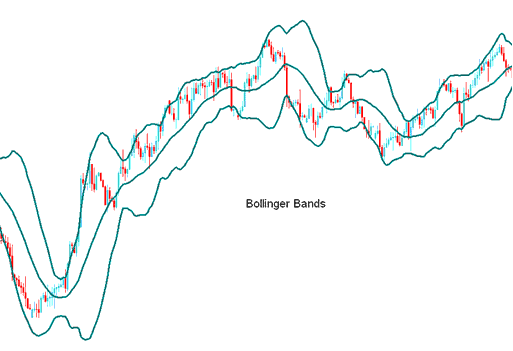
Metal Analysis and How to Generate Trading Signals
- Bands provide a relative definition of high & low
- Used to identify periods of high & low volatility
- Used to identify periods when metals prices are at extreme areas
the Squeeze
The bands tighten as volatility lessens, this identifies periods of consolidation. Sharp metals price break-outs tend to occur after the bands tighten.
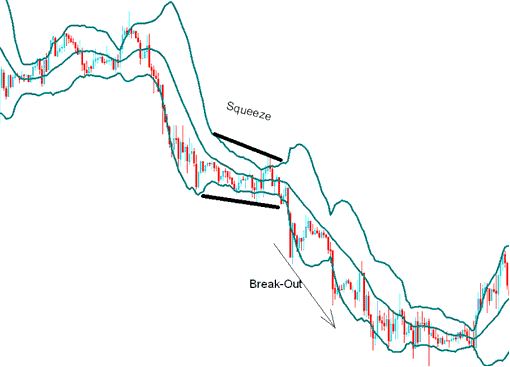
Consolidation Pattern
the Bulge
If metals prices break through the upper or lower band move outside the bands a continuation of the current metals trend is expected.

Double Tops & Double Bottoms
Bottoms & tops made outside the bands followed by bottoms and tops made inside the bands call for reversals in the trend
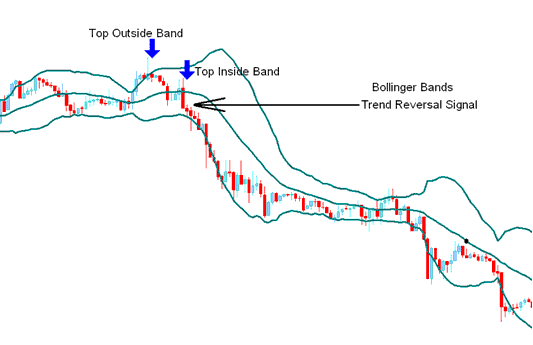
The Head Fake - Metals Trading Whipsaw
Traders should be on lookout for false breakouts known as whipsaws or head fakes.
Metals Price often breaks out in one direction immediately following the Squeeze causing many traders to think the breakout will continue in that direction, only to quickly reverse & make the true, more significant break-out in opposite direction.
Traders acting quickly on the initial breakout often get caught on the wrong side of the metals price action, while those traders expecting a 'false breakout' can quickly close out their original position and enter a trade in the direction of the reversal. It is always good to combine Bollinger bands with other confirmation Indicators.