RSI Strategy
- RSI Overbought and Oversold Levels
- RSI Divergence Setups
- RSI Classic Bullish and Bearish Divergence
- RSI Hidden Bullish and Bearish Divergence
- Swing Failure Strategy
- RSI Metal Chart Patterns Metals Trend Lines
- RSI Summary
RSI Indicator Strategy
RSI or RSI is one of the most popular metals indicator used in metals trading. It is an oscillator metals indicator which oscillates between 0 -100. This a metals trend following metals indicator. It indicates the strength of the metals trend, values above 50 indicate a bullish metals trend while values below 50 indicate bearish Metals trend.
RSI Metal Technical Indicator Measures Momentum of a Metal Trend.
The center-line for the RSI is 50 metals indicator, crossover of the center-line indicate shifts from bullish to bearish metals trend & vice versa.
Above 50, the buyers have greater momentum than the sellers and metals price on the metals chart will keep going up as long as this RSI indicator stays above 50.
Below 50, the sellers have greater momentum than the buyers and metals price on the metals chart will keep going downwards as long as RSI indicator stays below 50.
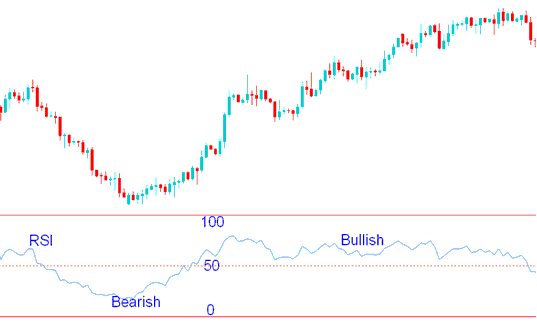
RSI Metal Indicator - How to Trade Metals with RSI Technical Indicator
In the metal trading example above, when the metals indicator is below 50, the metals price kept moving in a downward metal trend. The metals price continues to move down as long as RSI indicator was below 50. When the RSI indicator moved above 50 it showed that the momentum had changed from sell to buy and that the downward metals trend had ended.
When the RSI indicator moved to above 50 the metals price started to move upwards and the metals trend changed from bearish to bullish. The metals chart price continued to move upwards and the RSI indicator remained above 50 afterwards.
From the metal trading example above, when the metals trend was bullish sometimes the RSI would turn downwards but it would not go below 50, this shows that these temporary moves are just retracements because during all these time the metals price metals trend was generally upwards. As long as RSI indicator does not move to below 50 the current metals trend remains intact. This is the reason the 50 center line mark is used to demarcate the signal between bullish and bearish metals trade signals.
The RSI technical indicator uses 14 day period as the default period, this is the period recommended by J Welles Wilders when he introduced it. Other oftenly used periods used by Metals traders are the 9 & 25 day moving average.
RSI technical indicator period used depends on the metal chart timeframe you're using to trade, if you are using day metal chart timeframe the 14 period will represent 14 days, while if you use 1 hour metal chart timeframe the 14 period will represent 14 hours. For our metal examples we shall use 14 day moving average, but for your trading you can substitute the day period with the chart timeframe you are metals trading with.
To Calculate RSI Metals Trading Indicator:
- The number of days that a metals market is up is compared to the number of days that the metal market is down in a given time period.
- The numerator in the basic formula is an average of all the metals trading sessions that finished with an upward metals price change.
- The denominator is an average of all the down metals trading sessions closes for that period.
- The average for the down days are calculated as absolute numbers.
- The Initial RSI is then turned into an oscillator.
Sometimes very large up or down movement in metals price in a single metals trading session metals price period may skew the calculation of the RSI average and produce a false metals signal - whipsaw metals signal - in the form of a spike.
RSI Center-line: The center-line for this metals indicator is 50. A value above 50 implies that the metal market trend is in a bullish phase as average gains are greater than average losses. Values below 50 indicate a bearish phase in the metal market metals prices are generally closing lower than where they opened.
Overbought and Oversold Levels: Wilder set the RSI overbought and oversold levels at which the metal market moves are overextended at 70 and 30.