Metals Leverage & Margin Guide
The definition of Metals Trading Leverage is having the ability to control a big amount of money using very little of your own money and borrowing the rest - this is what makes the metal market to attract many investors.
We shall explain metals trading leverage first & then explain metals trading margin in this learn how to calculate metal trading leverage & margin tutorial.
Example:
We shall us this example to explain what metals leverage is? If your metals broker gives you metals leverage of 100:1 (this is the best option to choose as the maximum metals leverage for any metals trading account)
This means you borrow 100 dollars for every dollar you've in your metal trading account.
To put in another way your metals broker gives you 100 dollars for every 1 dollar in your trading account. This is what's referred to as metal trading leverage.
This means if you open an account with $1,000 & your metal leverage is 100:1, then you will get $100 for every $1 you that you've, the total amount that you will control is:
If for 1 dollar the broker will give you 100
Then if you have 1,000 you will get a total of:
$1,000 * 100 = 100,000 dollars
Now you control 100,000 dollars of Investment
Most new metals traders ask what metals leverage is best metals leverage for 1,000 dollars, or 2,000 dollars, or 5,000 dollars metals account? - The best metals leverage option to choose when opening a live metal account is always 100:1 & not 400:1.
What is Metals Trading Margin?
Metals Trading Margin is the amount of money required by your metal broker so that to allow you to continue trading with the borrowed amount.
In other words the question what is margin in Metals Trading? can be explained as money required to cover open metal trades and is expressed in percent. For 100:1, the amount you'll control is 100,000 dollars as described in the above example.
Now can you compare a investing $1,000 with another one that is investing $100,000? Obviously Not. This is how it works: it takes you from that retail investing $1,000 to that investor investing $100,000. Where does this extra cash come from? - You borrow it from your metals broker in what is simply known as Metals Leverage. This money which you borrow, you borrow it against the $1,000 dollar of your own money which you deposit with your metal broker. If you were to explain what this metals trading leverage means - then it is ability to control a large amount of money using very little of your own money and borrowing the rest. Otherwise, if you were trade Metals Trading without this metals leverage it would not be as profitable as it is, in fact you can still select not to use metal leverage, using 1:1 leverage option but you wouldn't make money & it would take too long to make any profit.
Example of how to calculate metal leverage and margin:
Metals Trading Margin required in this case is 1,000 dollars (your money) if it is expressed as a percentage of 100,000 dollars in your metals account which you control it is:
If metals leverage = 100:1
1,000 / 100,000 * 100= 1%
Margin required = 1%
(1/100 *100= 1%)
'Trade Forex Trading - Please simplify because I am Beginner'
(Simplify - your capital is $1,000 after metals leverage you control $100,000 - $1,000 is what percentage of $100,000 - it is 1 %) that is your margin requirement for your metal trading account.
The metals trading margin example illustrated and explained below, the set metal leverage is 100:1, the margin which is 1% is $2683.07, therefore the total amount controlled by the trader is: $268,307 - this is because with this leverage the trader has used little of his money & borrowed the rest, with this set at 100:1, the trader is using 1 % of their capital, this 1% is equivalent to $2683.07, if 1% is equal to $2683.07 then 100% is $268,307
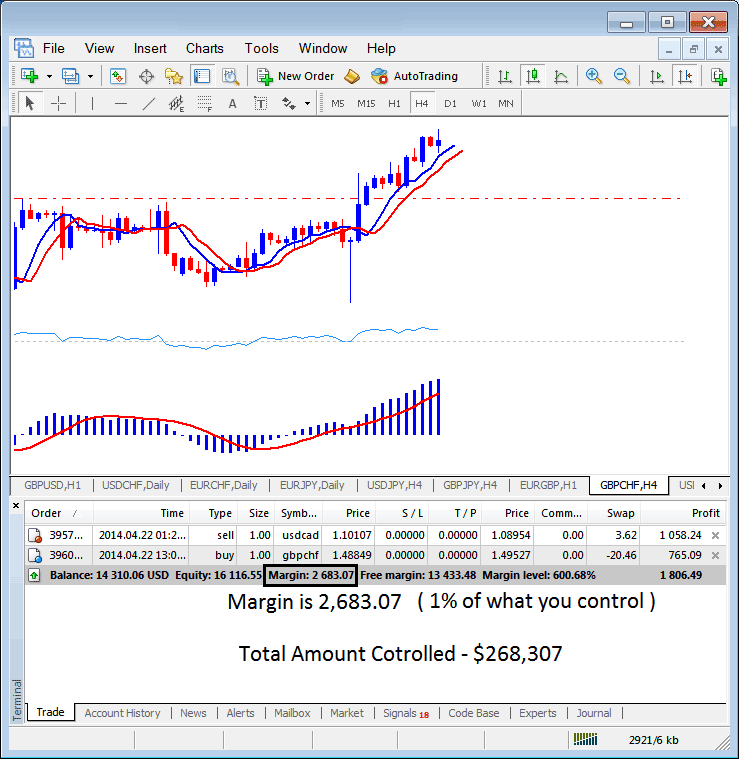
MT4 Transactions Window Panel - Metals Leverage & Margin Tutorial
- If = 50:1 Metals Trading Leverage
Then margin requirement = 1/50 *100= 2 %
If you have $1,000,
1,000* 50 = $50,000.
1,000 / 50,000 * 100= 2%
(Simplify - your capital is $1,000 after metals leverage you control $50,000 - $1,000 is what percentage of $50,000 - it is 2%) that is your metals trading margin requirement
- If = 20:1 Metals Leverage
Then the requirement = 1/20 *100= 5 %
If you have $1,000,
1,000* 20 = $20,000.
1,000 / 20,000 * 100= 5%
(Simplify - your trading capital is $1,000 after metals leverage you control $20,000 - $1,000 is what percentage of $20,000 - it is 5%) that is your metals trading margin requirement
- If = 10:1 Metals Leverage
Then the requirement is = 1/10 *100= 10 %
If you have $1,000,
1,000* 10 = $10,000.
1,000 / 10,000 * 100= 10%
(Simplify - your trading capital is $1,000 after metals leverage you control $10,000 - $1,000 is what percentage of $10,000 - it is 10%) that is your metals trading margin requirement
What is The Difference Between Maximum Metal Leverage & Used Metals Trading Leverage?
However, you should note that there is a difference between maximum metals trading leverage ( metals trading leverage given by your metals broker which is the highest metals leverage you can trade with if you select to) & used metals trading leverage ( metals leverage depending on the lots you've opened/open trade positions). One is the broker's (Maximum Metals Trading Leverage) & the other is trader's (Used Metals Trading Leverage). To explain this metals leverage concept we shall use metal trading example above:
If your metals broker has given you 100:1 Maximum Metals Leverage, but you only open a trade of 10,000 dollars then Used Metals Trading Leverage is:
10,000 dollars: 1,000 dollars (your money)
10:1
Your have used 10:1 Metals Leverage, but your maximum is still 100:1 Metals Leverage. This means that even if you are given 100:1 Maximum Metals Leverage or 400:1 Maximum Metals Leverage, you don't have to use all of it. It is best to keep your used metals leverage to a maximum of 10:1 but you will still choose 100:1 maximum metals leverage option for your trading account. The extra metals leverage will give you what we call Free Metals Margin, As long as you've some Free margin on your metals trading account then your trades will not get closed by your metals broker because this margin requirement will remain above required level.
When it comes to metals trading one of your rules: metals money management guidelines on your trading plan should be to use metals trading leverage below 5:1.
In the above image example, the trader is using $2683.07, the total controlled amount is $268,307, but account equity is $16,116.55, therefore used metal leverage is ($268,307 divide by 16,116.55) = 16.64 : 1
16.64 : 1 Used Metals Trading Leverage
Metals Trading Margin accounts allows traders to control a large amount of metals trading units using little of their own trading capital while borrowing the rest
Obtaining this metals account will enable you to borrow money from the broker to trade metals trading lots with.
The amount of borrowing power your trade account gives you what is called ' metals leverage', & is usually expressed as a ratio - a ratio of 100:1 leverage means you can control resources worth 100 times your deposit amount.
What this means in Metals Trading terms is that with 1% margin in your metals account you can control a trade worth $100,000 with a $1,000 deposit.
However, Trading this metals account increases both potential for profits as well as losses. In Metals Trading you can never lose more than you invest, losses are limited to your deposits and usually brokers will close a transaction that extends beyond your deposited amount by executing a margin call. Metals traders must therefore try to keep their trading margin requirement level above that required. By using metals money management guidelines and keeping your used metals trading leverage below 5:1.