Draw Down vs Maximum Draw-down
In any business, to make money, you have to figure out how to handle the dangers. To make money in trading, a trader first needs to learn and understand how to handle the market's risks. To make money when trading in this online indices market, you need to learn about the different ways to manage your money that are talked about on this Learn Stock Indices Trading Website.
In trading, you manage risk to avoid losses. Following indices money management rules not only protects your account but also helps you stay profitable over time.
Draw-down
Traders face drawdown as their top risk. It means the money lost from one trade on your account.
With $10,000 capital, a $500 loss means 5% drawdown. Divide the loss by total capital.
Maximum Draw-down
Drawdown is the total loss on your account before profits kick in. Say you start with $10,000. You lose $1,500 over five bad trades. Then you gain $4,000 from ten good ones. That $1,500 loss is 15% of your capital.
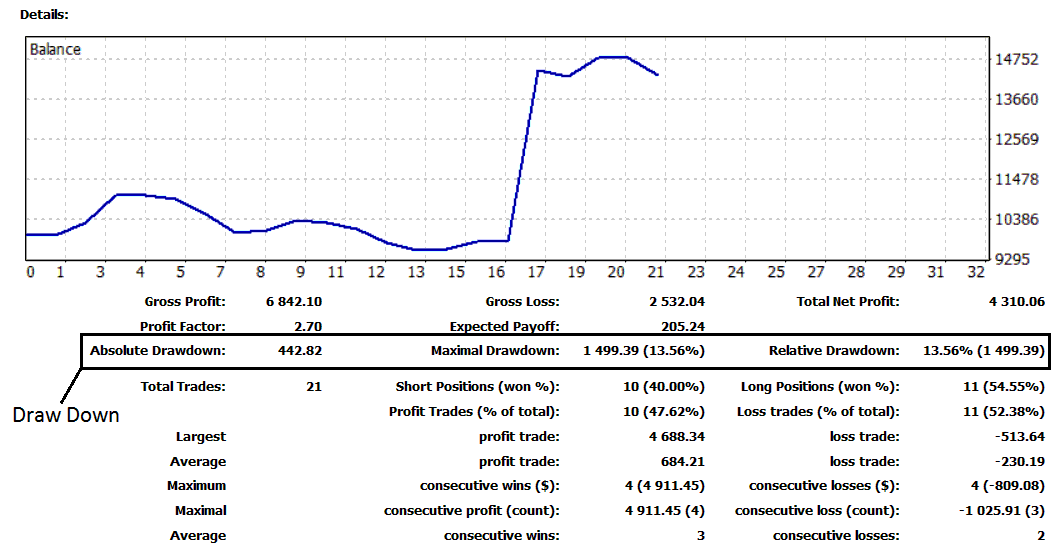
Draw-Down is $442.82 dollars (4.40 %)
Maximum Draw Down is $1,499.39 dollars (13.56%)
To learn and know how to get the above trading reports using MT4 software: Generate Reports on MT4 Tutorial
Indices Capital Management
The illustration explained below shows the difference between risking a small percentage of your trade capital in comparison to risking a higher %. Good investment principles requires you as a not to risk more than 2 percent of your total trading equity.
Percent Risk Technique
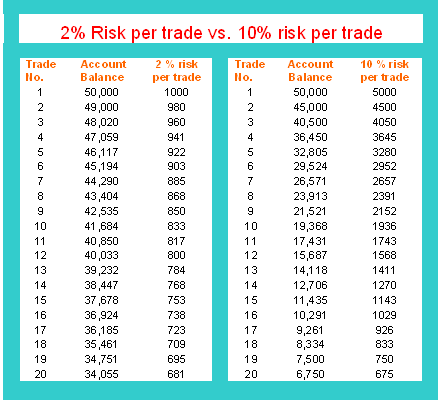
2 percent & 10 % Risk Rule
There is a big contrast between risking 2 % of your equity compared & analyzed to risking 10 % of your trade capital on a single trade.
If you happened to be on a losing streak and lost 20 trade transactions in a row, and you risked 10% on each one, you would have gone from a beginning trading equity balance of $50,000 dollars to only $6,750 dollars dollars in your trading account. You would have lost more than 87.5% of your equity.
However, if you only risked 2% you would have still had $34,055 which is only a 32 % loss of your total equity. This is why it's best to use the 2 percent risk management method
The difference between risking 2% and 10% is that if you risked 2 % you would still have $34,055 after 20 losing trade transactions.
Risking 10% per trade leaves you with $32,805 after five losses. That's worse than risking 2% over 20 losses.
The idea is that you, as a stock trader, want to create your trading rules so that even when you have a period of losses, you still have enough money to trade again later.
If you have lost 87.5% of your trading capital, you would need to generate a 640% profit to return to break-even.
As compared & analyzed to if you lost 32 percent of your trade capital you would have to make 47 % profit to go back to the break-even. To compare & analyze it with the illustrations 47% is much easier to break even than 640% is.
Chart below shows what percent you would have to make to get back to break even if you were to lose a certain % of your trade capital.
Concept of Break-Even
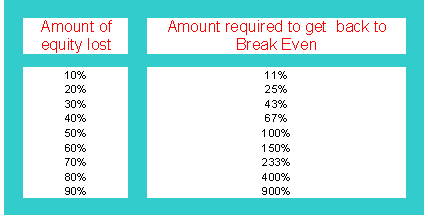
Account Equity & Break-Even
At 50% draw-down, one would have to make 100% on their capital - a task accomplished by less than 5 percent of all traders globally - just to break even on an account with a 50 % loss.
If a trader's money drops by 80%, they have to increase their money four times to get back to the starting amount. This is known as "breakeven," which means getting back to the original amount of money you put in.
The more you lose, the harder it's to make it back to your original account size.
This is the reason why you should do everything you can to PROTECT your equity. Don't accept to lose more than 2% of your equity on any 1 single trade position.
Indices trading money management is about only risking a small percent of your trading capital in each trade so that you can survive your losing streaks and avoid a big draw down on your account.
In index trading, stop loss orders limit losses. Risk control requires a stop loss after you place a trade.
Effective Equity Management
Effective risk management requires controlling all the trading risks. One should create a clear indices trading money management system and a plan. To be in Indices or in any other biz you must make decisions which involve some risk. All aspects should be measured to keep risk to a minimum and use the above tips on this course.
Get More Tutorials and Topics:
- How Can I Add FTSE 100 in MetaTrader 4 Android App?
- How Can I Trade MT4 Trade Chart Online?
- Setting up Fibonacci Extension on MetaTrader 4 Index Charts
- How to Create a Stock Index Trading Strategy
- What is UKX 100 Spreads? UKX100 Bid Ask Spread
- How Do I Place and Set a Stop Loss Order on MetaTrader 5 Online Platform Software?
- Index MT5 Introduction to MetaTrader 5 Interface
- McGinley Dynamic Stock Index Technical Indicator Analysis
- Best Strategy to UK100 Tutorial
- How Can I Add Nasdaq 100 on MetaTrader 4 Android App?
