Index Money Management Styles and Methods in Indices Trading
Best way to practice successful money management in Stock Indices is for a trader to keep losses lower than the profits they make. This is called risk to reward.
Account Management Trading Strategies
This way helps you make more money with your investing plan by only trading when you could possibly make three times as much money as you are risking on the trade.
If you invest using a high risk-reward ratio of 3:1 or more, you greatly increase your chances of becoming profitable in the long-run. Chart below indicates to you how:
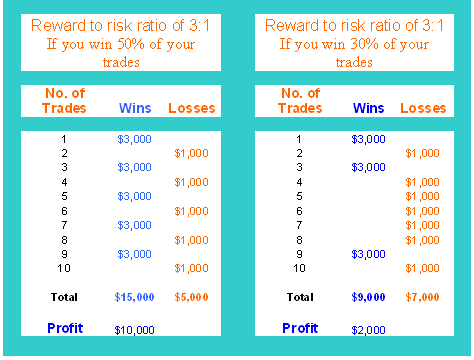
The illustration shows that even with only 50% winning trades, you could still earn a profit of $10,000 in your account.
Even if your win rate went lower to about 30% you'd still end up profitable - Trading Account Management Principle - Money Management.
Just remember that whenever you've got a good risk:reward ratio, your chances of being profitable as a trader are much greater even if you have a lower win percentage for your strategy.
Never use a risk-to-reward ratio where you could lose more points on one trade than you hope to gain. It doesn't make sense to risk $1,000 to try and make only $100.
Since you need to win 10 times to make back the $1,000. If you lose just once, you have to give back all the money you've earned.
This investment strategy is illogical and will result in long-term losses.
Account Management Strategies
The percentage risk method is one in which you risk the same percentage of your total account value for each trade - Trading Account Management Methods.
The risk-based percentage method dictates that a fixed proportion of your total account equity will be exposed to risk for every position taken. To compute the percentage risk for an individual trade, two pieces of data are essential: the risk percentage you have pre-determined and the specified lot size of the pending stock order, which is necessary to determine the exact placement of the stop-loss order. Since the percentage risk is known, this figure will be leveraged to calculate the appropriate lot size for the trading order to be opened in the marketplace: this determination is what is termed position sizing.
Example
If you as trader have an account balance of $50,000 in your account and risk % is 2%
Then 2 % is equivalent to $1,000
Other factors & aspects to consider include:
Maximum Number of Open Trade Positions
Think about the max number of open trades you want. This is key in managing your stock equity. Decide it based on your setup.
If, for instance, a trader opts for a 2% risk setting, they might concurrently decide to limit their exposure to a maximum of five open trade positions at any given moment. Should four of those five positions close out at a loss on the same trading day, the total reduction in the trading account equity for that day would amount to 8%.
Invest with Sufficient Capital
Traders make a big error in index trading by opening accounts with too little money.
A trader who doesn't have much money to invest will be anxious, trying to cut down losses beyond what makes sense, and might be removed from trades before they can succeed with their trading strategy.
- Exercise Discipline
For any stock index trader aiming for profitability, the most crucial attribute to cultivate is discipline, which involves precisely planning one's trading activities and rigorously adhering to that plan.
Patience lets a trade grow without pulling out too soon due to risk fears. Discipline means sticking to your index plan even after losses hit. Work hard to build that discipline level. It paves the way for steady profits.
Managing Account Capital Basics
Index money management, is the foundation of any trading system as it helps investors to improve their chances to get profit trading on the trading market. It's especially important when transacting in the leveraged stock market, which is considered to be probably one of the more liquid financial online trading markets but at same time also one of the riskiest ones.
To achieve successful market investment, recognizing the paramount importance of a sound money management strategy is crucial, particularly since trade orders will be executed utilizing leverage – essentials for Trading Account Management.
The difference between how much you make and how much you lose should be carefully calculated: what you make should typically be more than what you lose when trading, or else you will not make any money. In this case, a trader must come up with their own rules for managing their account, and each trader's success depends on their own unique personal qualities. Therefore, each trader comes up with their own plan and creates their own rules for managing their money based on the rules and advice mentioned above.
Always implement stop-loss orders when submitting trade requests to mitigate the possibility of substantial losses. Stop Loss orders can also serve the dual purpose of securing existing profits.
Think about the chance of making money versus the chance of losing money as 3:1 - this should be better on the side of making money.
By adhering to these rules and guidelines, you can enhance the profitability of your strategy and endeavor to develop your own trading approach that may yield substantial profits.
Study More Tutorials & Courses:
- How to Use Index TTF Trend Trigger Factor Indicator
- How Do You Interpret When a Stock Index Trend is Ending?
- How Can I Add Dow Jones Index on MT5 Android App?
- Overbought and Oversold Levels on Stochastics Oscillator Shown
- How to Get DJ30 Index in MetaTrader 4 iPhone Trade App
- Ehler Laguerre Relative Strength Index Indicator Analysis
- Can You Start Index Trade with $10?
- Index Buy Long Trades & Sell Short Trades in Index Charts
- How to Trade IBEX35 Tutorial Lesson to Trade IBEX35 Index
- Index Trade Strategies using RSI Index Trade Indicator
