CFD Pivot Points
Pivot points is a set of indicators created by floor traders in the commodities markets to ascertain the potential turning points, also known as 'pivots'. These points are calculated to determine levels in which the sentiment of the cfd trend could change from 'bullish' to 'bearish.' CFD traders use these points as markers of support & resistance.
These points are calculated as the average of the high, low and close from the previous session:
CFD Trading Pivot Point = (High + Low + Close) / 3
Day traders use the calculated pivot-points to determine levels of entry, stops & profit taking, by trying to determine where the majority of other cfd traders may be doing the same.
A pivot-point is a cfd price level of significance in technical analysis of a financial market that is used by cfd traders as a predictive indicator of cfds price movement. It is calculated as an average of significant cfd prices (high, low and close) from the performance of a market in the prior trading period. If the cfd prices in the following period trades above the central point it is usually evaluated as a bullish sentiment, whereas if cfds price below central point is seen as bearish.
The central point is used to calculate additional levels of support and resistance, below and above central point, respectively, by either subtracting or adding cfds price differentials calculated from previous trading ranges.
A pivot and the associated support & resistance levels are often turning points for the direction of cfds price movement in a market.
- In an up cfd trend, the pivot point & the resistance levels may represent a ceiling level for the cfds price. If cfds price goes above this level the up cfd trend is no longer sustainable and a cfd trend reversal may occur.
- In a down cfd trend , a pivot point & the support levels may represent a low for cfds price level or a resistance to further decline.
The central pivot-point can then be used to calculate the support & resistance levels as follows:
Pivot points consist of a central point level surrounded by three support levels below it and three resistance areas above it. These points were originally used by floor traders on equity and futures exchanges because they provided a quick way for those traders to get a general idea of how the cfd market was moving during the course of the day using only a few simple calculations. However, over time they have also proved exceptionally useful in other markets as well.
One of the reasons they are now so popular is because they are considered a 'leading' (or predictive) technical indicator rather than a lagging indicator. All that is required to calculate the pivot points for the upcoming (current) day is the previous day high, low, and close cfd prices. The 24-hour cycle pivot points in this indicator are calculated according to the following formulas:
Central pivot can then be used to calculate the support & resistance levels as follows:
Resistance 3
Resistance 2
Resistance 1
Pivot Point
Support 1
Support 2
Support 3
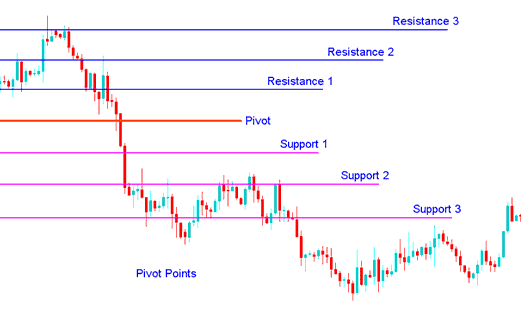
Pivot Points Support & Resistance Levels
Pivot Points as a CFD tool
The pivot point itself represents a level of highest resistance or support, depending on the overall sentiment. If the cfd market is direction-less ( range bound ) cfd prices will often fluctuate greatly around this level until a cfd price breakout develops. CFD Prices above or below the central point indicates the overall sentiment as bullish or bearish respectively. This cfd indicator is a leading CFD indicator that provides signals of potentially new highs or lows within a given chart timeframe.
The support and resistance levels calculated from the central pivot point & the previous market width may be used as exit points of the open CFD trades, but are rarely used as entry signals. For example, if the cfds price is up-trending and breaks through the pivot point, the first or second resistance level is often a good target to close a position, as the probability of resistance and reversal increases greatly, with every resistance level.
In pivot-point analysis 3 levels are oftenly recognized above & below the central point. These are calculated from the range of cfds price movement in previous trading period and then added to the central point for resistances and subtracted from it for support areas.
Pivot Points
Pivot levels can be used in many different ways. Here are a few of the most common methods for utilizing them:
CFD Trend Direction: Combined with other CFD Trading analysis techniques such as overbought/oversold oscillators, volatility measurements, etc., the central point may be useful in determining the general trending direction of the market. Trades are only taken in direction of the CFD trend. Buy trades occur only when the cfds price is above the central point and sell cfds trades occur only when the cfds price is below the central pivot.
CFD Price Breakouts: In cfds price breakouts, a bullish buy cfd signal occurs when the cfds price breaks up through the central point or one of the resistance levels (typically Resistance 1). A short sell cfd signal occurs when cfds price breaks down through the central point or one of the support levels (typically Support 1).
CFD Trend Reversals: In cfd trend reversals, a buy cfd signal occurs when the cfds price moves towards a support level, gets very close to it, touches it, or moves only slightly through it, and then reverses and starts moving in the other direction.
To download Pivot points:
https://c.mql5.com/21/9/pro4x_pivot_lines.mq4
Once you download it open it with MQL4 Language MetaEditor, Then Compile the technical indicator by pressing the Compile Button & it will be added to your MetaTrader 4.
NB: Once you add it to your MT4, the technical indicator has additional lines named Mid-Points, to remove the additional lines open MQL4 Meta Editor(shortcut keyboard key - press F4), and change line 16 from:
Extern bool midpivots = true:
To
Extern bool midpivots = false:
Then Press Compile button again, and it will then appear as exactly illustrated on www.tradegoldtrading.com web site.