Bollinger Bands Metals Trading Strategies
- How Bollinger Bands Works
- Bollinger Bands Market Volatility Analysis
- Bollinger Bands Bulge and Squeeze
- Bollinger Bands Metals Price Action in Trends
- Bollinger Bands Metals Price Action in Range
- Bollinger Bands and Metals Trend Reversals
- Bollinger Bands Metals Trading Strategy Summary
Bollinger Bands Metals Trading Indicator Strategy
Bollinger Bands indicator acts as a measure of volatility. Bollinger Bands indicator is a metals price overlay indicator.
Bollinger Bands indicator consists of 3 lines or bands: the middle band (moving average), an upper band a lower band. These three bands will enclose the metals price & the metals price action will move within these three bollinger bands.
Bollinger Bands indicator forms upper & lower bands around a moving average. Default moving average for bollinger bands metals technical indicator is the 20-SMA. Bollinger Bands indicator use the concept of standard deviationss to form their upper and lower Bands.
The example of Bollinger Bands indicator is shown below.
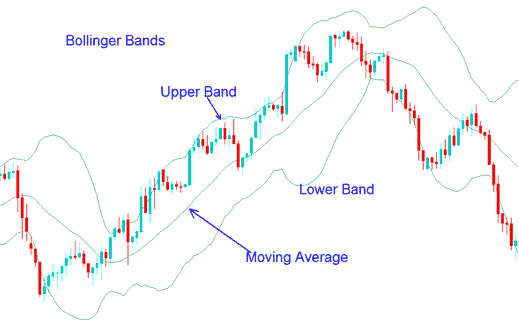
Bollinger Band Metal Indicator - How to Trade Metals with Bollinger Band Strategy
Because standard deviation is a measure of metals price volatility and volatility of the metal market is dynamic, the metals trading bollinger bands keep adjusting their width. Higher metals price volatility means higher standard deviation and the more the bollinger bands widen. Low metals price volatility means the standard deviation is lower and the bollinger bands contract.
Bollinger Bands forex indicator use metals price action to give a large amount of metals price action movement information. The metals price information given by the this bollinger bands metals indicator includes:
- Periods of low volatility- consolidation phase of the metals market.
- Periods of high volatility - extended trends, trending metals markets.
- Support and resistance levels of the metals price.
- Buy and Sell points of the metals price.