Bollinger Bands Metals Price Action in Ranging Metals Trading Markets
Bollinger Bands Metals Trading Indicator is also used to identify periods when a metals market trend is overextended. The guidelines below are considered when applying this metals indicator to a sideways metal trend.
Bollinger Bands Metals Trading Indicator is very important because it is used to give metals trading signals that a metals price breakout may be upcoming.
During a metals trending market these techniques do not hold, this only holds as long as Bollinger Bands are pointing sideways.
- If the metals price touches the upper band it can be considered overextended on the upside - overbought.
- If the metals price touches the lower band the metals price can be considered overextended on the bottom side - oversold.
One of the uses of Metals Bollinger Bands indicator is to use the above overbought and oversold metals trading guidelines to establish buy and sell targets during a ranging metals trading market.
- If metals price has bounced off the lower band crossed the center-line moving average then the upper band can be used a sell level.
- If metals price bounces down off the upper band crosses below the center moving average the lower band can be used as a buy level.
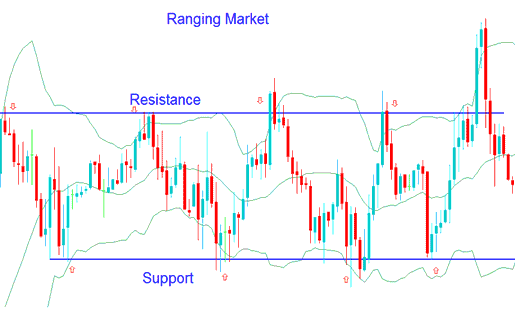
Trading Bollinger Bands in Ranging Metals Markets - Bollinger Bands Strategy
In the above ranging metals market the instances when the metals price hits the upper or lower bands can be used as profit targets for long/short metals trade positions.
Metals trades can be opened when the metal market hits the upper resistance level or lower support level. A stop loss metals order should be placed a few pips above or below depending on the metals trade opened, just in case the metals price action breaks out of the range within these Bollinger bands.