MACD Metals Classic Bullish & Bearish Divergence
MACD Metals Trading Classic divergence is used as a possible sign for a metals trend reversal. MACD classic divergence is used when looking for an area where metals price could reverse and start going in the opposite metals trend direction. For this reason MACD classic divergence is used as a low risk entry method and also as an accurate way of exit out of a metals trade transaction.
1. It is a low risk technique to sell near the metal market top or buy near the metal market bottoms, this makes the risk on your metal trades are very small relative to the potential reward.
2. It's used to predict the optimum point at which to exit a Metals trade.
There are two different types of Metals Trading Classic Divergence:
- Metals Classic Bullish Divergence
- Metals Classic Bearish Divergence
Metal Classic Bullish Divergence in Metal Trading
Classic bullish divergence in metals trading occurs when metals price is forming lower lows (LL), but the oscillator technical technical indicator is making higher lows ( HL ).
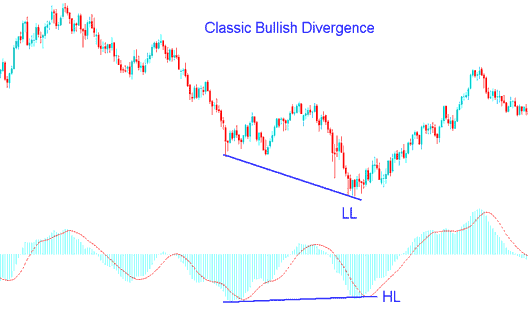
MACD Metals Classic Bullish Divergence in Metals Trading - MACD Divergence Strategy
Classic bullish divergence in metals trading warns of a possible change in the metals trend from down to up. This is because even though the metals price went lower the volume of sellers that pushed the metals price lower was less as illustrated by the MACD indicator. This indicates underlying weakness of the downward metal trend.
Classic bearish divergence in Metal Trading
Classic bearish divergence in metals trading occurs when metals price is forming a higher high (HH), but the oscillator technical technical indicator is lower high ( LH ).
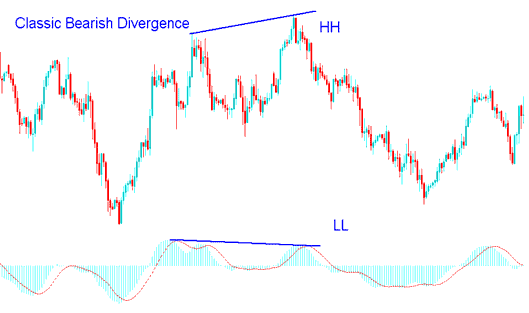
MACD Metals Classic Bearish Divergence in Metals Trading - MACD Divergence Metals Strategy
Classic bearish divergence warns of a possible change in metal market trend from up to down. This is because even though the metals price went higher the volume of buyers who pushed the metals price higher was less as illustrated by the MACD indicator. This indicates underlying weakness of the upward metal trend.