How to Trade Metals Trading Classic Bullish Divergence & Bearish Divergence
In metals trading, classic divergence is used as a possible sign for a metals trend reversal and is used by metals traders when looking for an area where metals price could reverse and start going in the opposite direction. For this reason this metal trading setup is used as a low risk entry method and also as an accurate way of exit out of a metals trade transaction.
This trading strategy is a low risk technique to sell near the top or buy near the bottom, this makes the risk on your trades are very small relative to the potential reward. However, this is one technique with very many whipsaws & most traders don't recommend using it.
Divergence in Trading is also used to predict the optimum point at which to exit a trade. If you already have an open trade that's already profitable, a good way to identify a profit taking level would be the point where you identify this metals trading setup.
There are two types, based on the direction of the Metals trend:
- Classic Bullish divergence
- Classic Bearish divergence
Metal Classic Bullish Divergence
Classic bullish divergence setup forms when metals price is forming lower lows (LL), but the oscillator is making higher lows (HL). The example illustrated and explained below shows a picture of this metals trading setup.
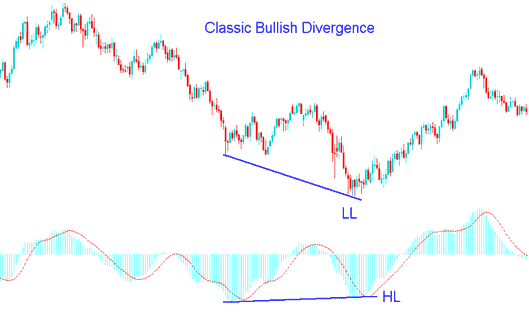
Metals Classic Bullish Divergence
This example uses MACD indicator as a Metals divergence indicator.
From the above example the metals price made a lower low(LL) but the indicator made a higher low(HL), this shows there is a divergence between the metals price & indicator. This signal warns of a possible metals trend reversal.
Classic bullish diverging trading signal warns of a possible change in the metals trend from down to up. This is because even though the metals price went lower the volume of sellers that pushed the metals price lower was less as illustrated by MACD technical indicator. This indicates underlying weakness of the downward Metals trend.
Classic bearish Metals Trading Divergence Setup
Classic bearish divergence setup occurs when metals price is forming a higher high (HH), but the oscillator is lower high (LH). The image below shows an example of the setup.
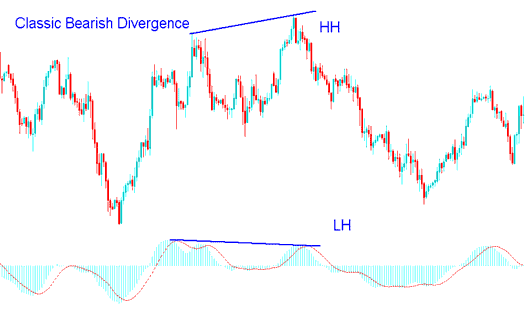
Metals Classic Bearish Divergence
This example also uses MACD indicator
From the above example the metals price made a higher high(HH) but the indicator made a Lower High(LH), this shows there is a divergence between the metals price & indicator. This signal warns of a possible metals trend reversal.
Classic bearish diverging signal warns of a possible change in the metals trend from up to down. This is because even though the metals price went higher the volume of buyers who pushed the metals price higher was less as illustrated by the MACD indicator. This indicates underlying weakness of the upward Metals trend.
In the above example, if as a trader you had used divergence trade setup to trade you would have gotten good signals to enter or exit the trades at an optimal point. However, divergence trading signals just like other indicators, is also prone to whipsaws. That is why it's always good to confirm the diverging trading signals with other indicators such as the RSI, Moving Averages & Stochastic Oscillator.
A good indicator to combine classic diverging setups is the stochastic oscillator and wait for the stochastic lines to move in the direction of the divergence signal so as to confirm the trading signal.
Another good technical indicator to combine with is the moving average technical indicator, in this indicator a trader should use the Moving Average Crossover System
Examples of Moving Average Crossover Method Strategy
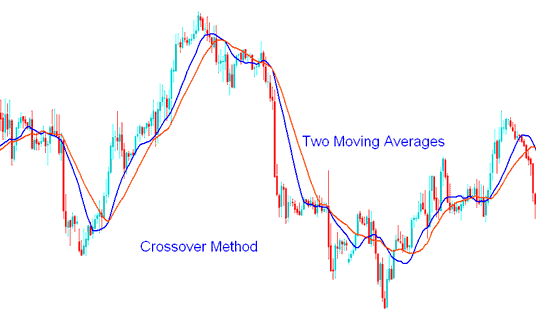
Once the divergence trading signal is given, a trader will then wait for the Moving average cross-over system to give a trading signal in the same direction, if there is a classic bullish setup, a trader will wait for the moving average system to give an upwards cross-over signal, while for a bearish classic divergence signal the trader should wait for the Moving average cross over system to give a downwards bearish cross-over trading signal.
By combining the classic divergence signals with other indicators this way, a trader will be able to avoid whip-saws when it comes to trading the classic diverging signals, because the trader will wait until the metal market has actually reversed and is already moving towards this direction, hence the trader will not fall into the trap of picking market tops and bottoms.