The Elliott Wave Theory in Metals Trading
This is a form of technical analysis that Metals traders and other investors use to forecast trends in the metal markets by identifying extremes in investor trading psychology, highs and lows in metals prices, and other collective activities. This metals trading theory model shows that collective human trading psychology develops in natural trading patterns over time, through buying and selling decisions reflected in market metals prices.
This trading theory of analysis was developed by Ralph Nelson Elliott that is based on the theory that, in nature, many things happen in a five-wave pattern. These patterns are also applied to technical analysis trading, to analyze the behavior of Metals market trends using this Elliott Wave technical analysis theory.
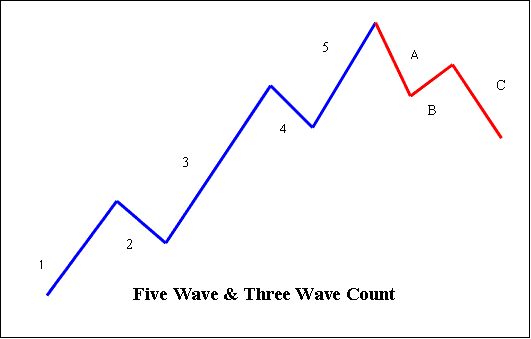
When this theory is applied to Metals, the assumption is that the metal market will advance in a pattern of five waves - three up ones, numbered 1, 3 and 5 - which are separated by two down ones, number 2 and 4. When the three up moves(1,3,5) are combined with the two down moves(2,4), they form the 5 Wave pattern.
The theory further holds that each five-pattern upward move will be followed by a downward move also consisting of a three-pattern down moves - this time, three down ones are not numbered but use the letters A, B and C. So as to differentiate them from the 5 ones for the up move.
5 and 3 Wave Pattern
The main metals trend will comprise five moves while the retracement will comprise 3 moves.
Five pattern (dominant trend) - uses 1, 2, 3, 4, 5
Three pattern (corrective trend) - uses A, B, C
This article is about how to trade online metals markets using the Elliott Theory as the driving force of metals trading instruments. This technical analysis model relies heavily on looking at metals price charts. Technical analysts use this theory to study developing Metals trends to identify the waves and discern what metals prices may do next.
By analyzing these patterns on a metals chart and applying the Elliott Theory, metals traders are able to decide where to get in and where to get out by identifying the points at which the metal market is likely to turn.
One of the easiest places to see this trading theory at work is in the metal market, where changing investor psychology is recorded in the form of metals price movements. If a trader can identify repeating patterns in metals prices, and figure out where these repeating metals trading pattern is relative to the Elliot pattern counts then the trader can predict where metals prices are likely to head to.
Rules for Elliott Count in Metals Trading
Based on the metal market patterns formations formed by this analysis theory, there are several guidelines for valid Counts:
- Wave 2 should not go below the beginning of Part 1.
- Wave 3 should be the biggest among Part 1, 3 & 5.
- Wave 4 should not overlap with Part 1.
Five pattern (dominant trend)
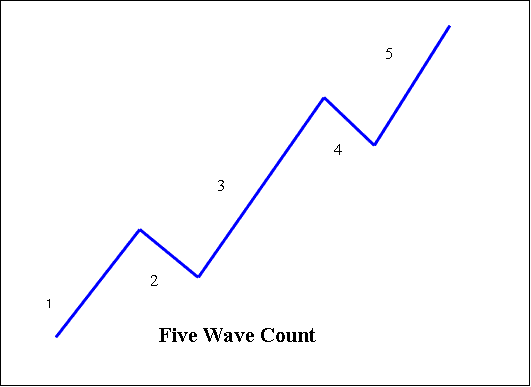
1: This one is rarely obvious at its inception. When the first wave of a new bull market begins, the fundamental news is almost universally negative. The previous metals trend is considered still strongly in force. Fundamental analysts continue to revise their estimates lower; the beginning of a new trend probably does not look strong. Sentiment surveys are still bearish and the implied volatility in the metal market is high. Volume might increase a bit as metals prices rise, but not by enough to alert many technical trading analysts.
2: This one two corrects 1, but can never extend beyond the starting point of wave one. Typically, the news is still bad. As metals prices retest the prior low, bearish sentiment quickly builds, and "the crowd" mentality reminds all that the bear market is still in force. Still, some positive signs appear for those who are looking: volume should be lower during 2 than during 1, metals prices usually do not retrace more than 61.8% of 1 part one gains. Metals Price will reach a low that is higher than the previous low resulting into a higher low.
3: This is usually the largest and most powerful move upwards, larger than 1 and 5. News is now positive & fundamental analysts begin to raise estimates. Metals Prices rise quickly, corrections are short-lived & shallow. Anyone looking to get in on a pull-back will likely miss the boat. As 3 starts, the news is probably still somewhat bearish, and most traders remain negative: but by part 3 midpoint, the crowd will often join in & agree the new market sentiment is bullish. Wave 3 will extends beyond the highest level reached by 1.
4: This is typically and clearly corrective. Metals Prices might move sideways for an extended period, and 4 typically retraces less than 38.2% of 3. Volume is well below that of wave three. This is a good place to buy a pull back if you understand the potential ahead for a Part 5. Still this 4 is often frustrating because of their lack of progress in the larger upwards trend.
5: This is the final leg in the direction of the dominant trend. The news is almost universally positive and everyone is bullish. Unfortunately, this is when many average investors finally buy in, right before the metals price hits the top. Volume is often lower in 5 than in wave three, and many momentum indicators start to show divergences (metals prices reach a new high but the indicators do not reach new highs). At the end of a major bullish trend, bears may very well be ridiculed, for trying to pick a market top.
Three Pattern (Corrective Trend)
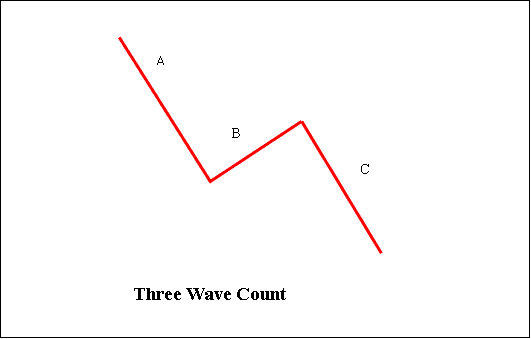
A: Corrections are typically harder to identify than impulse moves. In A of a bearish market, the fundamental news is usually still positive. Most analysts see the drop as a correction in a still active bullish market. Some metals indicators that accompany A include increased trading volume, rising and implied volatility and possibly a higher open interest in short selling.
B: Metals Prices reverse & move slightly higher, which many see as a resumption of the now long gone bullish trend. Those familiar with classical technical analysis may see the peak as the right shoulder of a head and shoulders reversal metals trading pattern. The volume during B should be lower than in A. By this point, fundamentals are probably no longer improving, but they most likely have not yet turned negative.
C: Metals Prices move impulsively lower. Volume picks up, and by the third leg of C, almost everyone realizes that a bearish metals trend is firmly entrenched. C is typically at least as large as A and often extends to 1.618 Fibo expansion level beyond A lowest point.