Stock Indicators For Setting Stop losses In Stock Trading
Some stock indicators are used for setting stop losses taking away the need for stocks traders to perform complex calculations on where to place these stop loss stock trade orders.
A stock trading systems trader can also place a stop loss stock order according to these indicators. Some stock indicators use mathematical equations to calculate where the order stop loss stock order should be set so as to provide an optimal exit. These stock indicators can be used as the basis for setting stop loss stock orders. These stock indicators follow stocks price action of a stock trading instrument closely and define the boundaries which the stock prices should move along in. When the stocks price moves outside these boundaries it is therefore best to close the open stocks trades because stocks price stops moving in that particular direction.
Some of the Technical stock indicators that can be used to set stop loss stock orders are:
Parabolic SAR Indicator
Parabolic SAR is like an Automatic Stop Loss Stock Order & Take Profit Stock Order Indicator used to set a trailing stocks price stop loss
The Parabolic SAR provides excellent exit points.
In an upwards stock trend, you should close long trades when the stocks price falls below the Parabolic SAR technical indicator
In a downward stock trend, you should close short trades when the stocks price rises above the Parabolic SAR.
If you are long then the stocks price is above the parabolic SAR, the SAR will move upward every day, regardless of the direction in which the stocks price is moving. Amount the Parabolic SAR indicator moves up depends on the amount that stock prices moves.
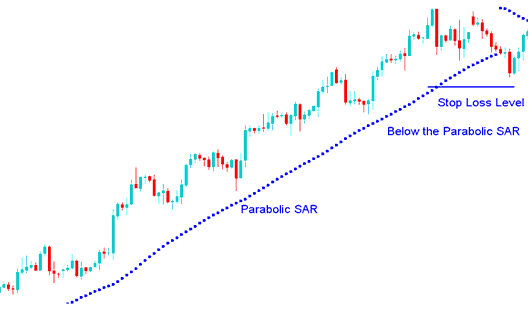
Parabolic SAR - Stocks Indicator - Automatic Stop Loss Stock Order & Take Profit Stock Order Technical Indicator
Picture of parabolic SAR & how it is used
Bollinger Bands Technical Indicator
Bollinger bands indicator use standard deviations as a measure of volatility. Since standard deviation indicator is a measure of volatility, the Bollinger bands are self-adjusting meaning they widen during periods of higher volatility and contract during periods of lower volatility.
Bollinger Bands indicator consist of 3 bands designed to encompass the majority of a stock trading instruments stocks price action. The middle band is a basis for the intermediate term stock trend, typically it is 20 period simple moving average, which is also the base for upper & lower bands. The upper band's distance and lower band's distance from middle band is determined by volatility of trading price.
Since these Bollinger bands are used to encompass the stocks price action, the bands can be used by stocks traders to set stop-losses outside the area just outside of these bands.
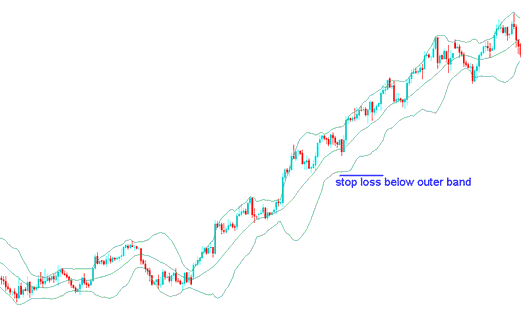
Bollinger Bands Setting Stop Loss Stock Order Level - Bollinger Bands Stock Technical indicator
Stocks Fibo Retracement Levels Indicator
Fib retracement levels provide areas of support and resistance, these can be used to set stoploss levels.
Stock Trading Fibonacci Retracement level 61.8 % is the most commonly used level for setting stop losses. A stop loss stock order should be set just below 61.80% Fibonacci retracement level
The 61.8 % Fib retracement level trading indicator is used to set these orders because its rarely hit.
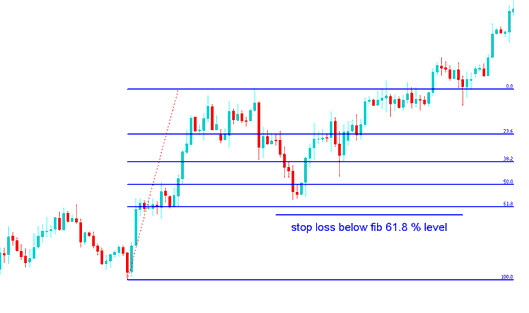
Fibo Indicator StopLoss Stock Order Setting at 61.80% Retracement Level
Fibonacci retracement level 61.8% - Fibonacci Indicator
Support & Resistance Levels Lines
Support and resistance levels can be used to set stop loss levels where the stop loss stock orders are set just above or below the support or resistance.
- Buy Stock Trade - Stop Loss Stock Order set few pips below the support
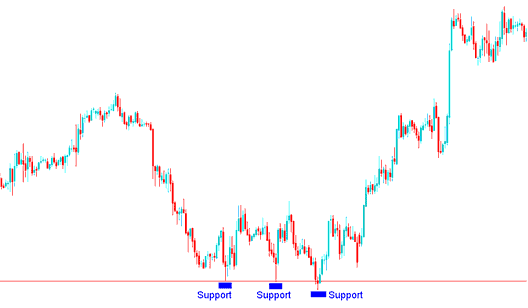
Buy Stock Trade - Stop Loss Stock Order set a few pips below the support
- Sell Stock Trade - Stop Loss Stock Order set few pips above the resistance
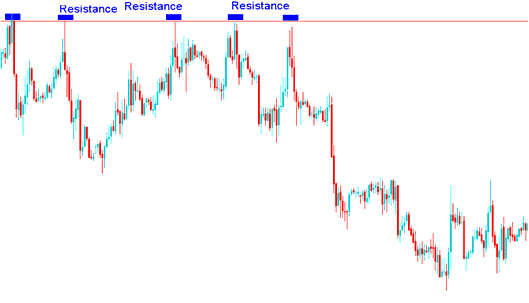
Sell Stock Trade - Stop Loss Stock Order set a few pips above the resistance